

How Does International Air Freight Work?
A shipment can miss its planned flight for surprisingly simple reasons - the paperwork is incomplete, the cargo was not packed to airline standard, or the terminal cut-off was missed by an hour.
That is why businesses asking how international air freight works are usually not looking for theory. They need to understand the operational process that gets cargo accepted, cleared and uplifted without avoidable delays.
International air freight is the movement of commercial goods by air between countries using scheduled airline cargo services and specialist air cargo networks. The process involves planning, booking, customs compliance, cargo handling, airline uplift and final delivery coordination.
How does international air freight work in practice?
At a practical level, international air freight starts with shipment planning. Before space is booked, the freight forwarder or air freight specialist needs to confirm what is moving, where it is going, how quickly it needs to arrive, and whether the cargo is subject to any restrictions. Weight, dimensions, commodity type, packing method, origin, destination and required transit time all affect the routing and service options.
Once those details are confirmed, suitable airline capacity is identified. This is where commercial air freight differs from a simple courier booking. Airline schedules, cargo terminal cut-offs, transit connections and destination handling arrangements all need to align. A routing that looks fast on paper may be unsuitable if the connection time is too tight for the cargo type or if customs processing at destination is likely to add delay.
After the booking is secured, the shipment moves into documentation and compliance review. The exact documents vary by trade lane and commodity, but commonly include the commercial invoice, packing list, export declaration data and any licences or certificates required for controlled goods. If the freight includes dangerous goods, the checks become more detailed because classification, packing, marking, labelling and documentation must meet IATA Dangerous Goods Regulations.
The core stages of an air freight shipment
The physical movement usually begins with cargo collection or delivery into a receiving depot. Some shippers send freight directly to the handling point, while others use a depot service for consolidation, checking and preparation before airport transfer. This stage matters because errors are easier to correct before the cargo reaches the terminal than after it is presented for airline acceptance.
At the depot or handling point, the freight may be measured, weighed and checked against the booking. If dimensions differ from what was declared, the chargeable weight can change and the booked capacity may no longer be suitable. Packaging is also reviewed. Airlines and terminals will not accept freight that is insecure, poorly stacked or inadequately protected for handling.
From there, the shipment is prepared for export customs processing where required. For UK exports, customs data must be submitted correctly and on time. If commodity descriptions are vague, values do not match the invoice, or the exporter and consignee details are inconsistent, customs intervention may follow. Air freight is fast, but it still depends on administrative accuracy.
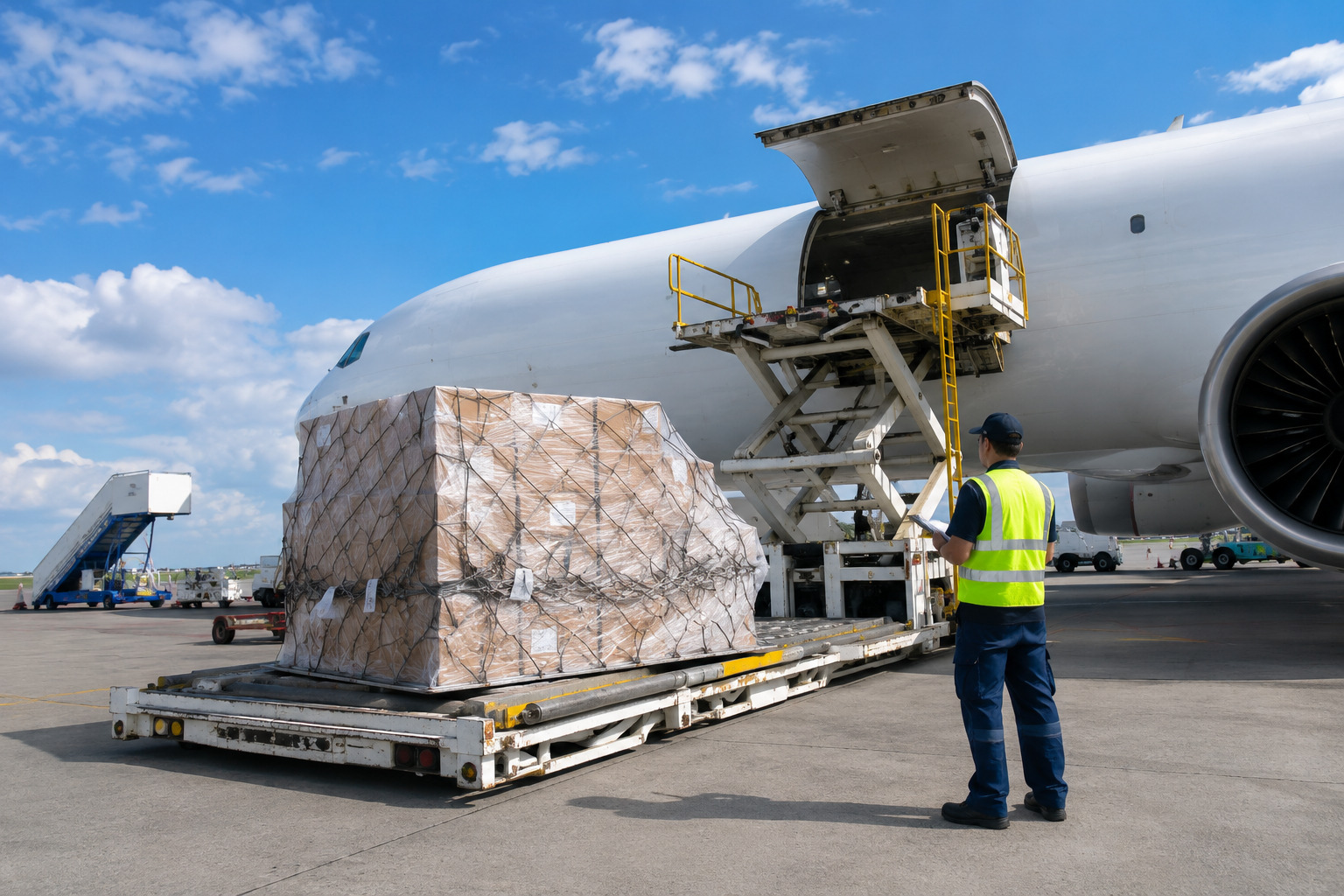
Once customs formalities and pre-flight checks are in order, the cargo is transferred to the airline's cargo terminal. There it passes through the formal acceptance process. Acceptance includes document matching, security status checks, piece count verification and confirmation that the cargo complies with the airline's conditions of carriage. If accepted, it is built for carriage, which may involve loading onto a unit load device or preparing it for loose loading depending on the service and aircraft type.
The flight stage is only one part of the journey, but it is the point at which the cargo is officially uplifted. Uplift means the goods have been loaded onto the aircraft and departed on the booked flight. For business customers, that distinction matters. A shipment may be booked and accepted, but until uplift takes place, it has not yet moved internationally.
Documentation keeps the freight moving
The air waybill is central to the shipment. It acts as the transport document for the air carriage and ties together the key shipment information used by the airline, terminal operators and destination agents. It is not the same as a bill of lading used in ocean freight, and it does not operate as a document of title in the same way. Its value is operational - it helps ensure the cargo is identified, routed and processed correctly.
Supporting paperwork is just as important. Commercial invoices need accurate values, product descriptions and buyer-seller details. Packing lists should reflect the physical shipment as tendered. Where goods are controlled, certificates or licences must match the actual commodity and destination requirements. Small inconsistencies can lead to holds, inspections or rework at origin or destination.
For dangerous goods, there is even less room for error. Classification must be correct, packaging must be approved where required, and the declaration must be completed precisely. Goods that are acceptable by road may still be restricted or prohibited by air. This is one of the clearest examples of why specialist review matters before the cargo reaches the airline terminal.
Customs and clearance are part of the process, not an afterthought
A common misconception is that air freight is mainly about flight speed. In reality, customs readiness often determines whether the shipment moves as planned. Export clearance at origin and import clearance at destination need to be considered from the start, especially where commodity codes, duty treatment, valuation or supporting certificates are involved.
For imports into the UK, pre-arrival coordination can reduce delays once the aircraft lands. For exports, accurate declarations support timely departure. If customs data is incomplete or submitted too late, the cargo may miss its intended uplift even when the airline booking itself is secure.
This is also where integrated support has practical value. When freight booking and customs coordination are handled together, there is greater control over timings, document alignment and exception management. That does not remove every risk, but it reduces the number of handovers where information can be lost or misunderstood.
What affects transit time and reliability?
Not every air freight shipment moves at the same speed. Direct flights are typically faster, but they may be more expensive or less frequent. Deferred services can reduce cost, though they introduce more time and sometimes more handling points. The best option depends on the cargo value, urgency, destination and tolerance for delay.
Several operational factors affect reliability. Airline capacity can tighten during peak seasons. Cargo terminal congestion may extend acceptance times. Security screening requirements can vary by shipment profile. Weather and network disruption also have an impact, particularly where the routing depends on multiple flights.
That is why realistic planning matters more than headline transit times. A well-managed shipment is built around actual cut-offs, connection windows and clearance requirements rather than an idealised schedule.
Where specialist coordination makes the difference
Businesses moving high-value, urgent or regulated goods often need more than a booking service. They need a partner that checks whether the cargo is ready for air transport before the shipment reaches the point of failure. That includes verifying packing, reviewing documents, aligning customs activity, monitoring airline schedules and managing exceptions when plans change.
For example, if cargo arrives late at a receiving depot, there may still be options to rework the route or secure a later flight. If dangerous goods paperwork is incomplete, corrective action may be possible before terminal presentation. If destination clearance requirements are known in advance, the consignee can be prepared before arrival. These are operational details, but they are usually what determine whether air freight performs as intended.
ACS Air Freight works within that managed model, coordinating bookings, compliance checks, customs support and cargo handling steps so business shipments move through established airline and terminal channels with proper control.
How does international air freight work for different cargo types?
The process is broadly similar across most commercial shipments, but the level of control varies by cargo type. General cargo is usually the most straightforward if it is well packed and properly documented. High-value goods may require tighter security handling and more careful routing choices. Oversized cargo may be restricted to specific aircraft or airports. Dangerous goods require formal compliance checks before acceptance can even be considered.
Temperature-sensitive goods, controlled products and time-critical spares also need planning that reflects the cargo's actual risk profile. The shipment may still move by standard airline networks, but the preparation and monitoring around it are more exacting.
That is the practical answer to how international air freight works: the aircraft is only one part of the solution. The real work happens in the planning, compliance, terminal coordination and customs control that make uplift possible. For businesses relying on air cargo, the most useful question is not simply how fast a shipment can fly, but whether every step before and after the flight has been properly prepared.
Need support with international air freight?
If you would like advice on an upcoming shipment or a quotation for international air freight services, contact our team and we'll be happy to help.