

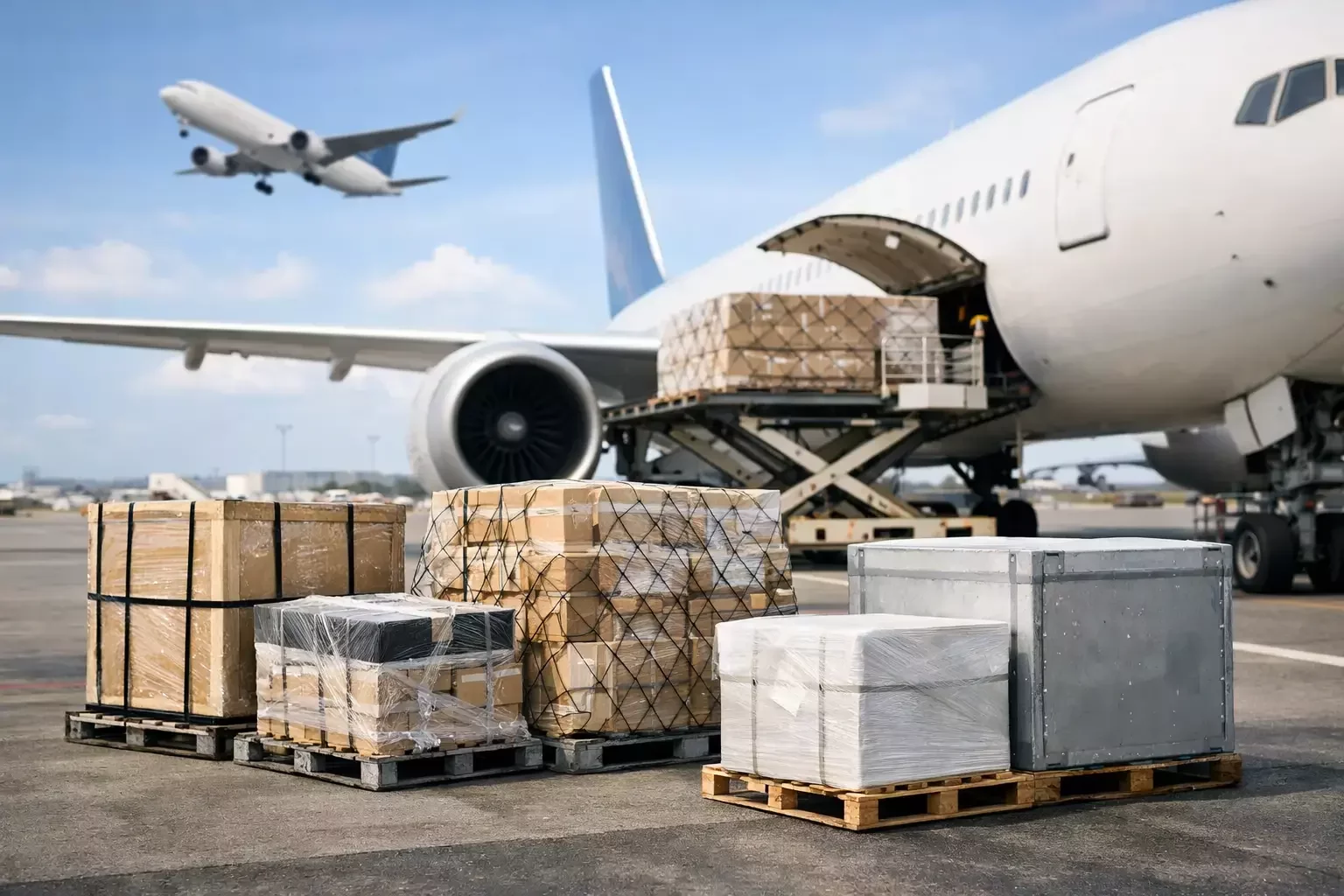
A shipment can be flight-ready on paper and still fail at the handling stage because the packaging was never designed for the realities of international air freight. Between export packing, cargo terminal handling, aircraft loading, customs inspection and final delivery, packaging does far more than keep cartons closed. Choosing the best packaging for international air cargo means balancing protection, compliance, handling efficiency, weight and the characteristics of the goods themselves.
For procurement teams, exporters and supply chain managers, the question is rarely which single packaging type is best. The more useful question is which packaging solution is right for this particular product, this route and these handling conditions. Air cargo moves quickly, but it still passes through multiple touchpoints, and every transfer introduces another opportunity for damage if the packaging has been under-specified.
What the best packaging for international air cargo needs to do
Good air cargo packaging has three core objectives. It must protect the goods from impact, compression and movement during transport. It must allow safe and efficient handling throughout warehouses, cargo terminals and delivery points. It must also meet any airline, customs or regulatory requirements that apply to the shipment.
That means packaging decisions should never be based on product dimensions alone. Weight distribution, stackability, sensitivity to moisture, theft risk, whether the goods are regulated and how frequently the freight will be handled all influence the correct solution. Packaging that performs perfectly within a domestic road network may not be suitable once the shipment enters the international air cargo chain, particularly for high-value, fragile or time-critical freight.
The strongest packaging is not automatically the best packaging. Heavy-duty timber crates may provide excellent protection, but they also increase chargeable weight and handling costs. Lightweight carton solutions can reduce freight costs, but if they collapse under stacking pressure or allow internal movement, those savings disappear quickly once damaged goods need replacing.
The objective is to achieve the right balance between protection, compliance, handling efficiency and transport cost.
Cartons, crates and pallets – choosing the right outer packaging
Corrugated cartons
Corrugated cartons remain one of the most practical packaging options for commercial air freight, particularly for boxed products, components and retail-ready goods. They perform well when the contents are relatively uniform, not excessively heavy and already protected by suitable internal packaging.
Board strength is critical. Double-wall and triple-wall cartons generally provide far better resistance to compression and handling damage than standard single-wall boxes, making them more suitable for export movements where freight may be stacked, transferred and handled several times before delivery.
Cartons should also be selected according to the product weight rather than simply its size. Oversized cartons containing dense products often fail because the packaging specification was designed around dimensions rather than load.
Timber crates
Timber crates are generally the preferred option for machinery, industrial equipment, fragile products, irregularly shaped cargo and high-value commercial goods where impact or crush damage cannot be tolerated.
A well-built crate provides a rigid protective structure while allowing goods to be securely restrained internally. It also performs well where repeated forklift handling is expected throughout the journey.
Exporters should remember that timber packaging used for international shipments may need to comply with international phytosanitary regulations. Heat treatment and ISPM 15 marking requirements should always be confirmed before export to avoid customs or import delays.
Palletised freight
For many commercial shipments, palletisation provides the best balance between protection and handling efficiency. A correctly built pallet keeps multiple cartons together as one stable load, speeds handling throughout the supply chain and reduces unnecessary manual movement.
However, pallet quality depends on how the load is built. Cartons should not overhang the pallet edges, heavier items should sit at the bottom of the stack and the overall load should remain square and balanced. Stretch wrap alone is rarely enough. Corner boards, banding and suitable top protection significantly improve stability during transport.
Poor pallet construction often creates more handling problems than weak packaging materials.
Internal protection matters as much as the outer pack
The strongest outer packaging offers little protection if the goods are free to move inside it. During an international air freight movement, cargo may be transferred between collection vehicles, warehouse locations, screening facilities, cargo terminals, unit load devices and final delivery vehicles. Internal movement remains one of the most common causes of preventable freight damage.
The correct internal protection depends entirely on the product. Foam inserts, die-cut supports, corrugated dividers, moulded packaging, inflatable cushions and shock-absorbing materials all have their place when properly matched to the cargo.
Fragile products require cushioning that reflects both their weight and impact sensitivity. Dense industrial components can easily break through lightweight internal packaging, while delicate electronic equipment may require anti-static protection alongside physical cushioning.
There is always a balance between protection and efficiency. Excessive packaging increases shipment dimensions, potentially raising volumetric weight and freight cost. Too little protection reduces dimensions but exposes the cargo to damage throughout handling. The most effective solution is usually engineered around the product itself rather than selected from standard warehouse stock.
Well-designed internal protection also improves presentation during customs inspections. If cargo needs to be opened for examination, properly organised packaging makes it easier for customs officers to inspect and for handlers to reseal the shipment securely before onward transport.
Moisture, pressure and temperature risks
Not every air freight movement experiences the same operating conditions. Some shipments move directly between controlled airport facilities and arrive within hours. Others may be exposed to rain during loading, temporary storage, varying humidity levels, cold temperatures on the apron or customs delays before final delivery. Good packaging should be designed around the conditions the shipment is likely to encounter, not the ideal journey shown on a transport schedule.
Moisture protection is one of the most commonly overlooked areas. Corrugated cartons lose strength when damp, adhesive labels can detach and exposed metal components may begin to corrode surprisingly quickly. Poly wrapping, barrier bags, desiccants and moisture-resistant liners are relatively simple additions that can prevent costly damage, particularly on international movements passing through different climates.
Temperature-sensitive cargo demands an even more considered approach. Pharmaceuticals, food products, chemicals and certain electronic components may require insulated packaging, thermal blankets, gel packs or active temperature-control solutions. The objective is not simply to keep the goods cold or warm, but to maintain the required temperature throughout loading, flight, customs clearance and final delivery.
Packaging should therefore be viewed as part of the transport solution rather than something separate from it.
Load stability and handling compatibility
One of the simplest ways to reduce damage is to make freight easier to handle safely.
Cargo that can be lifted, stacked and screened efficiently is less likely to suffer delays or unnecessary handling. Airlines and cargo terminals naturally prefer freight that is stable, clearly labelled and suitable for mechanical handling where appropriate.
Palletised shipments should remain square, evenly balanced and securely restrained. Corner boards, top caps and correctly tensioned strapping provide significantly greater stability than stretch wrap alone. Stretch wrap helps contain the load, but it should never be relied upon as the primary structural support.
Weight distribution also deserves careful attention. Heavy products should sit low within the load to maintain a stable centre of gravity. Crates and pallets should be designed so they can be lifted safely from the intended forklift positions without placing unnecessary stress on the packaging.
Good packaging is not simply strong—it is designed around how the shipment will actually be handled throughout its journey.
Compliance and labelling are part of the packaging standard
The best packaging for international air cargo protects more than the goods. It also supports regulatory compliance.
Correct marks, labels and documentation all form part of the packaging standard. Orientation arrows, handling labels, consignee details, package numbering and country-specific markings should remain clear and legible throughout the journey.
For dangerous goods, packaging requirements become significantly more demanding. UN specification packaging, approved inner receptacles, absorbent materials, tested closures and the correct hazard labels may all be mandatory depending on the commodity.
Businesses shipping regulated cargo should also understand What is IATA DGR? before selecting packaging or preparing dangerous goods documentation. Proper packaging and compliance always work together rather than as separate processes.
Likewise, packaging should allow customs authorities to inspect the shipment where necessary without making it difficult or unsafe to re-secure afterwards. Export packaging that falls apart after inspection creates unnecessary delays and increases the risk of damage during the remainder of the journey.
When lighter packaging is not the best answer
Reducing packaging weight is an understandable objective because air freight charges are heavily influenced by chargeable weight. However, lighter packaging only delivers a commercial benefit if it still protects the shipment through every stage of the movement.
Replacing a timber crate with a lightweight carton may reduce freight costs, but those savings disappear quickly if the product arrives damaged or requires replacement. Likewise, reducing internal protection to save a small amount of space may increase the risk of vibration damage or internal movement throughout the journey.
The better approach is to consider the total commercial risk rather than packaging weight alone.
For robust, low-risk products, efficient export cartons and well-built pallets are often entirely appropriate. For precision equipment, calibrated instruments, specialist machinery or high-value industrial components, stronger packaging frequently protects far more than the goods themselves. It protects project schedules, customer commitments and production continuity.
Packaging decisions should therefore be made during shipment planning, not once the freight is already waiting for collection.
Our guide to the Airline Cargo Booking Process explains why operational planning begins well before cargo reaches the airport, including packaging, documentation and airline acceptance requirements.
A practical standard for exporters
The most reliable international air freight shipments rarely depend on one packaging material alone. They combine the right outer packaging with effective internal protection, stable load building and packaging methods suited to the conditions the cargo will actually experience.
For most commercial shipments, that means selecting packaging that matches the product weight and fragility, securing the contents against movement, building stable pallets where appropriate, protecting against moisture and environmental conditions, and ensuring the finished shipment complies with airline and regulatory requirements.
It does not mean every shipment requires bespoke timber crating or specialist export packaging. Many commercial consignments move perfectly well in properly specified cartons and palletised loads. What matters is selecting the packaging that suits the product rather than applying the same solution to every shipment.
Packaging should also be considered alongside documentation and compliance. Accurate packaging works together with Export Air Freight Documentation to reduce airline acceptance issues, customs queries and avoidable handling delays before departure.
Where dangerous goods, high-value equipment or difficult-to-handle freight are involved, early planning becomes even more important. A freight forwarder that manages booking, compliance, documentation and terminal handling together can often identify packaging issues long before they become expensive operational problems.
At ACS Air Freight, packaging is treated as part of the shipment plan rather than a warehouse task completed at the last minute. By considering packaging, documentation, customs requirements and airline handling together, businesses gain a more reliable movement from collection through to final delivery.
The most effective packaging is the packaging that arrives intact, passes airline acceptance without issue and protects the cargo through every transfer point. If a shipment is important enough to move by air, it deserves packaging that has been designed for the journey it is actually going to make.
Need Advice on Preparing Cargo for International Air Freight?
Whether you’re shipping fragile equipment, palletised freight, dangerous goods or high-value commercial cargo, ACS Air Freight can help you plan the movement from collection through to delivery. Our team can advise on packaging, documentation, customs requirements and airline acceptance to help reduce delays and protect your shipment throughout its journey.