

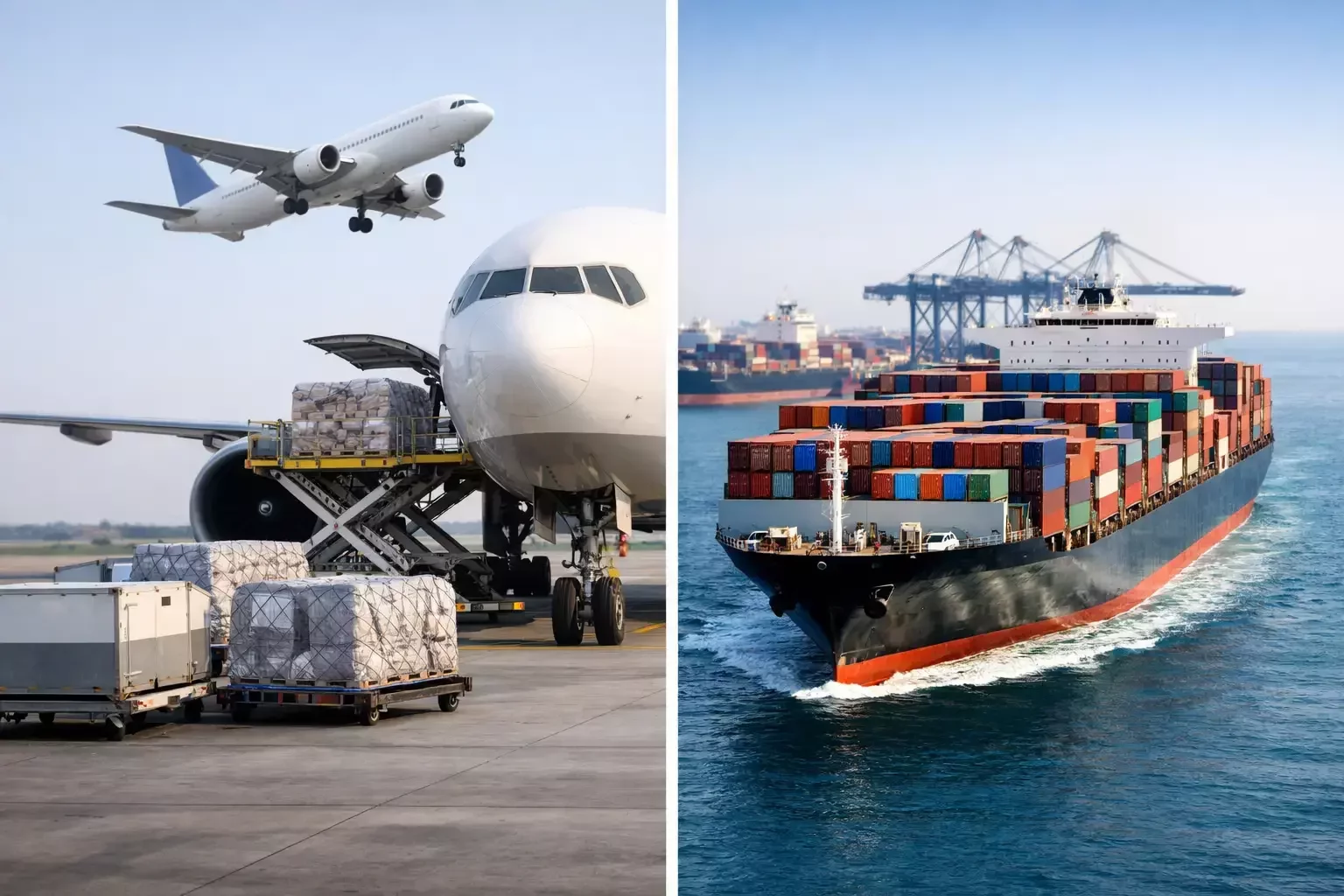
A production line waiting on one missing component is a costly way to learn that mode selection is not just a transport decision. When businesses weigh air freight against sea freight, the real question is usually broader: how much delay, stock exposure and handling risk can the supply chain absorb before the savings disappear?
For procurement teams, importers and exporters, the choice is rarely as simple as fast versus cheap. Lead time commitments, stockholding strategy, product value, customs timing, packaging requirements and onward delivery all affect whether air or sea is the better operational fit. The right answer depends on the cargo, the route and the commercial consequence of getting it wrong.
Air freight vs sea freight: the core difference
Air freight moves cargo quickly through airport terminals, airline networks and customs-controlled handling facilities. It is typically used where time matters, where goods are high value relative to volume, or where tighter control is needed over urgent or specialist shipments.
Sea freight moves larger volumes at a lower transport cost per unit, but with longer transit windows and more variables around port operations, vessel schedules and inland movements. It suits cargo that can tolerate extended lead times and is packed, booked and planned well in advance.
Although the distinction sounds straightforward, operational reality is usually more complex. The correct choice depends on balancing transport cost against commercial risk, inventory exposure and delivery commitments. A delayed sea shipment can affect production, customer service levels and warehouse planning for weeks. An air shipment can protect continuity, but if used routinely for goods that are not time-critical, it can expose avoidable logistics spend.
Speed matters, but so does predictability
The main advantage of air freight is transit time. Goods that might spend weeks moving by sea can often move internationally by air in days, sometimes faster where capacity and customs documentation are aligned early. For urgent replenishment, critical spare parts, launch stock and short-shelf-life goods, that time difference can protect revenue and keep operations moving.
However, speed alone is not the only point. Predictability also matters. Air freight generally offers tighter transit control, more frequent departures on many trade lanes and faster response when a shipment needs rebooking or reprioritising. That can be valuable where customer deadlines are fixed or supply chains are already under pressure.
Sea freight, by contrast, often works well when planning horizons are longer and inventory is buffered. But port congestion, vessel rollovers, transhipment delays and inland haulage disruption can all extend transit beyond the original schedule. For some businesses, that is manageable. For others, one missed arrival date can trigger wider cost elsewhere in the chain.
Cost is not just the freight rate
Sea freight is usually more economical for heavy, bulky or high-volume cargo. If a business is moving full container volumes, planning seasonal stock well ahead, or importing goods with stable demand patterns, sea freight can make strong financial sense.
However, freight cost should always be assessed in context. The landed cost of a slower shipment includes stock tied up in transit, warehouse planning, safety stock requirements and the risk of shortages if demand changes. A lower shipping rate can become less attractive if the business has to carry additional inventory or resort to emergency transport later.
Air freight usually carries a higher direct transport cost, particularly for volumetric cargo. Yet for goods with high unit value, urgent deadlines or significant commercial importance, that cost can be proportionate. If air freight prevents a production stoppage, protects a contract delivery date or avoids back-order penalties, the wider commercial case may be stronger than the freight invoice suggests. Businesses facing these situations should also read When Should Businesses Use Air Freight?
Which goods suit each mode?
Cargo profile is one of the clearest decision points when comparing air freight with sea freight.
Air freight is often the right fit for urgent components, electronics, pharmaceuticals, aerospace parts, samples, controlled consignments and high-value commercial goods. It is also commonly used where cargo security, reduced transit exposure or faster customs progression are priorities. Dangerous goods can move by air as well, but only where classification, packing, labelling and documentation meet airline and regulatory requirements.
Sea freight is usually better suited to dense cargo, palletised stock, machinery, raw materials, retail replenishment with longer lead times and goods where transport cost per unit needs to stay low. It is also often the practical option for oversized consignments that are not suitable for standard air cargo handling.
The key is not only what the goods are, but what they mean to the business. A low-value item can still justify air freight if it is operationally critical. Equally, a high-value product may still move by sea if volumes are stable and lead times are built into the supply plan.
Customs and documentation can change the equation
Businesses sometimes focus heavily on transit mode and overlook customs execution. In practice, customs readiness can determine whether the speed advantage of air freight is fully realised.
Air shipments move quickly, which means commercial invoices, packing data, commodity codes, origin information and any controlled goods checks need to be accurate before uplift. If documentation is incomplete, cargo can miss flights, incur storage charges or face clearance delays on arrival. Fast transport only works when paperwork keeps pace with the movement. Our guide to Air Cargo Customs for Commercial Shipments explains why customs preparation is often just as important as the transport mode itself.
Sea freight allows a longer planning window, but documentation errors can still create significant disruption, especially where container release, port handling or inland delivery depends on timely customs clearance. Delays at this stage can erode much of the cost benefit of moving by sea.
For importers and exporters dealing with controlled commodities, dangerous goods or multi-country movements, compliance should sit near the start of the mode decision rather than the end.
Packaging, handling and cargo exposure
Transit mode also affects how goods are packed and handled. Air freight usually involves tighter weight and dimension controls, terminal screening requirements and airline acceptance standards. Packaging must protect the cargo while remaining suitable for unit load handling and flight conditions.
Sea freight involves longer transit periods, greater exposure to moisture, container movement and repeated handling across ports and depots. Packaging therefore needs to be designed for duration as well as protection. Goods that are badly packed for sea can arrive looking intact externally but still suffer damage internally. Our article on Best Packaging for International Air Cargo explains how packaging standards differ depending on cargo type and transport mode.
This is especially relevant for specialist goods, sensitive equipment and cargo with handling restrictions. Choosing the right transport mode without adjusting packing standards is a common operational mistake.
Reliability depends on planning, not just mode
Neither air nor sea is automatically reliable without proper coordination. The strongest results usually come from realistic booking lead times, accurate shipment data and clear control over each handover point.
With air freight, that means checking dimensions and weights early, confirming airline acceptance requirements, aligning customs entry timing and managing airport-to-door delivery without unnecessary delay at destination.
With sea freight, it means booking against realistic vessel schedules, planning container availability, monitoring cut-off times and ensuring inland collection and customs clearance are arranged well before arrival.
This is where a single point of contact adds practical value. When one team oversees booking, compliance review, customs formalities and final delivery coordination, the shipment is less likely to lose time between stages.
When a mixed approach makes more sense
For many businesses, the answer is not choosing air or sea exclusively. It is using both strategically.
Core stock can move by sea on planned replenishment cycles, while urgent replenishment, launch quantities or delayed purchase orders move by air. This approach helps control transport spend without leaving the business exposed when demand changes or suppliers fall behind schedule. It is particularly effective for manufacturers and distributors balancing inventory efficiency against customer service levels.
A mixed transport strategy also helps when supply chains are recovering from disruption. Rather than switching an entire programme to air freight, businesses can use air selectively for the most commercially sensitive products while maintaining the wider flow by sea.
How to choose the right mode for a shipment
The most reliable way to choose between air freight and sea freight is to assess five factors together: required delivery date, cargo profile, stock position, customs readiness and the commercial impact if the shipment is delayed.
If the cargo is urgent, high value, time-sensitive or operationally critical, air freight is often justified. If the goods are bulky, less time-sensitive and planned well ahead, sea freight is usually the more efficient option. Where the decision is less obvious, the cost of delay often becomes more important than the cost of transport.
That is why transport mode selection should sit alongside procurement, production planning and customer delivery commitments rather than being treated as a standalone logistics decision. Freight works best when it supports the wider objectives of the supply chain.
For businesses moving international cargo regularly, choosing between air freight and sea freight is not a one-off decision. It is an ongoing planning discipline. Reviewing each shipment against urgency, operational risk and commercial consequence allows businesses to select the transport mode that delivers the right balance of cost, control and reliability. When timing genuinely matters, paying for faster transport is often far less expensive than paying for the disruption caused by delay.
Need help choosing between air and sea freight?
Every shipment has different commercial priorities. ACS Air Freight helps businesses assess urgency, cost, customs requirements and operational risk to recommend the most appropriate transport solution for each movement.
Whether your cargo travels by air, sea or a combination of both, we coordinate the shipment from booking through to final delivery.