

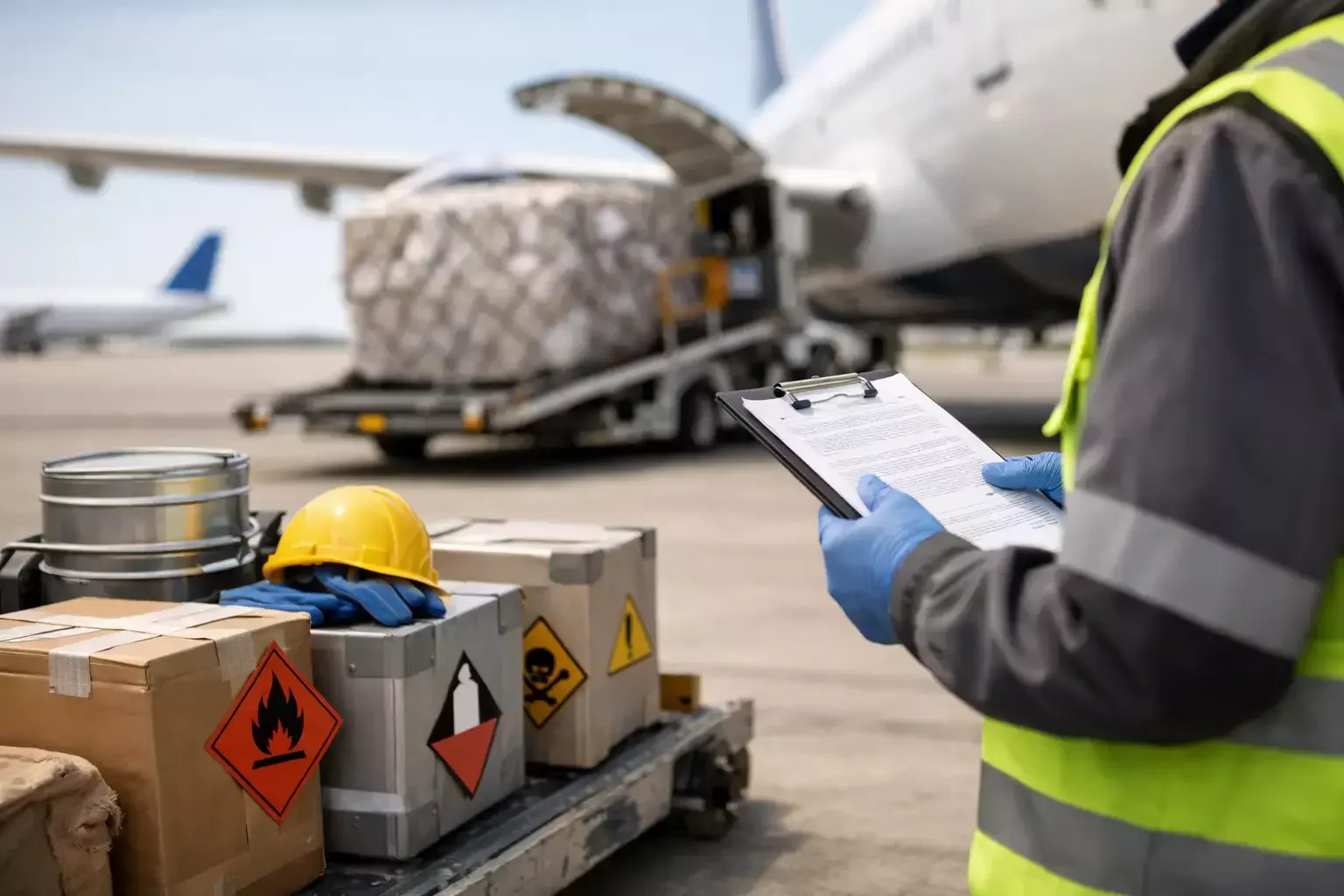
A hazardous shipment can be delayed long before it reaches the aircraft. In many cases, the problem is not the flight itself but an earlier compliance failure. The goods were classified incorrectly, the packaging did not meet specification, or the paperwork did not match the contents. Understanding how to ship hazardous materials by air starts with technical accuracy and ends with maintaining control throughout the entire movement.
For commercial importers and exporters, dangerous goods transport by air is highly regulated for good reason. Aircraft environments, terminal handling conditions and international acceptance rules leave very little room for error. Products that move routinely by road or sea can face much stricter requirements by air, while some hazardous materials may only travel on specific aircraft or under tightly controlled conditions.
How to ship hazardous materials by air without avoidable delays
The most effective approach is to treat dangerous goods shipping as a compliance process rather than simply another freight booking.
Before cargo reaches the airline, the shipper needs to establish exactly what the product is, whether it can travel by air, how it must be packed and which declarations, marks and labels are required.
That work starts with gathering accurate product information. Safety Data Sheets often provide valuable information, but they rarely tell the whole story. Air transport classification depends on the substance itself, its concentration, physical form, quantity per package, applicable packing instruction and any relevant exceptions or limitations. A broad product description on a commercial invoice is not enough.
Businesses unfamiliar with the regulations should first understand What is IATA DGR?, as these regulations form the basis of commercial dangerous goods transport by air.
Correct classification comes before everything else
Classification is the first and most important control point.
Every hazardous material travelling by air must be identified using the correct UN number, Proper Shipping Name, hazard class or division and, where applicable, packing group.
Lithium batteries add another level of complexity. Battery chemistry, watt-hour rating, configuration, installation status and state of charge can all influence whether a shipment is accepted and how it must be prepared.
This is where many dangerous goods delays begin. Internal stock codes, trade names or purchasing descriptions often bear little resemblance to the formal transport description required by airlines. Once classification is wrong, every document, label and packaging decision built upon it is also likely to be incorrect.
Where uncertainty exists, it is usually better to pause and verify than allow assumptions into the supply chain. A rejected dangerous goods shipment can lose several days before another compliant booking becomes available.
Air eligibility must be confirmed before booking
Not every hazardous material can travel on every aircraft.
Some substances are completely forbidden by air. Others are restricted to cargo aircraft only, while many are limited by package quantity, routing or airline-specific acceptance rules.
Flight planning therefore becomes just as important as packaging. A shipment may comply technically yet still fail because it has been booked on an unsuitable service or through an airport where additional restrictions apply.
Checking airline acceptance criteria before booking helps avoid rebuilding shipments after they have already reached the terminal.
Our guide to the Airline Cargo Booking Process explains why these operational checks should always happen before cargo is delivered to the handling agent.
Packaging is a compliance requirement
Packaging should never be viewed simply as a warehouse decision.
For dangerous goods moving by air, packaging is part of the regulatory requirement. Depending on the product, regulations may specify approved outer packaging, inner receptacles, absorbent materials, pressure-tested containers, closures and UN specification packaging tested to recognised performance standards.
Strong packaging alone is not enough.
The packaging must also correspond exactly with the applicable packing instruction and permitted package quantity. Where combination packaging is required, every component must comply as a complete system.
Temperature-control materials, dry ice, overpacks and mixed consignments introduce further complexity. Warehouse teams experienced with general cargo may still require specialist dangerous goods knowledge before preparing air freight consignments.
Businesses reviewing packaging requirements should also see our guide to Best Packaging for International Air Cargo.
Marks and labels must match the shipment
Correct packaging is only part of the process.
Every package must also carry the correct marks and hazard labels.
Depending on the shipment, this may include:
- UN numbers
- Proper Shipping Names
- hazard labels
- handling labels
- orientation arrows
- Cargo Aircraft Only labels
- lithium battery marks
- dry ice markings
Even relatively small discrepancies can prevent airline acceptance. Acceptance staff assess compliance against the regulations, not whether the shipment appears generally safe.
Documentation must support the cargo
Dangerous goods documentation has to align with the physical shipment and with the commercial paperwork.
Depending on the movement, documentation may include:
- Shipper's Declaration for Dangerous Goods
- Air Waybill
- Commercial Invoice
- Packing List
- Import or Export licences
- Product supporting information
- Customs documentation
The dangerous goods declaration remains one of the most important documents in the entire shipment. Transport descriptions, package quantities, packing instructions and authorisations all need to match the physical cargo exactly.
Customs documentation also deserves equal attention. Dangerous goods classification and customs commodity classification are different systems, but inconsistencies between them can still delay clearance.
Our article covering Export Air Freight Documentation explains how commercial documentation and customs formalities work alongside airline compliance.
Trained people make the biggest difference
Knowing how to ship hazardous materials by air is not only about preparing paperwork.
The people handling classification, packaging, checking, documentation and booking all play a critical role.
Ideally, dangerous goods shipments should be reviewed before collection takes place, allowing any discrepancies to be corrected while there is still time to adjust routing, packaging or airline selection.
Pre-shipment review is considerably easier than correcting problems after freight reaches the cargo terminal.
Why dangerous goods shipments fail at airline acceptance
Most rejected dangerous goods consignments follow familiar patterns.
Classification is incomplete.
Packaging is suitable for road transport but not for air.
Declarations have been copied from previous shipments without checking current requirements.
Operator restrictions have not been reviewed before booking.
Products that moved successfully several months ago are assumed to remain compliant despite packaging, airline or destination changes.
None of these issues are unusual.
Almost all are preventable with proper preparation.
Working with a freight partner
Many businesses choose to manage dangerous goods through an experienced air freight forwarder because compliance responsibilities extend well beyond booking aircraft space.
An experienced freight partner can review shipment information, verify acceptance conditions, coordinate compliant packaging, check documentation, secure suitable airline capacity and monitor the movement through customs, terminal handling and final delivery.
This becomes particularly valuable for urgent shipments, specialist destinations, cross-trade movements and airport-to-door deliveries where multiple operational stages need coordinating.
A managed Airport to Door Cargo Service helps ensure compliance remains consistent from collection through to final delivery rather than treating each stage separately.
Safe dangerous goods shipping starts long before the aircraft
If your business is reviewing how to ship hazardous materials by air, the safest approach remains straightforward.
Confirm classification first.
Verify the shipment is permitted by air.
Use approved packaging that matches the relevant packing instruction.
Apply the correct marks and labels.
Ensure every document matches the shipment.
Finally, build the movement around both the regulations and the intended routing rather than relying on assumptions or previous shipments.
The businesses that consistently move dangerous goods successfully are rarely the ones solving problems at the terminal. They are the ones asking the technical questions before the freight is packed, booked or collected.
Shipping Dangerous Goods by Air?
ACS Air Freight helps businesses move hazardous cargo safely through compliant packing, documentation, airline acceptance and customs coordination.