

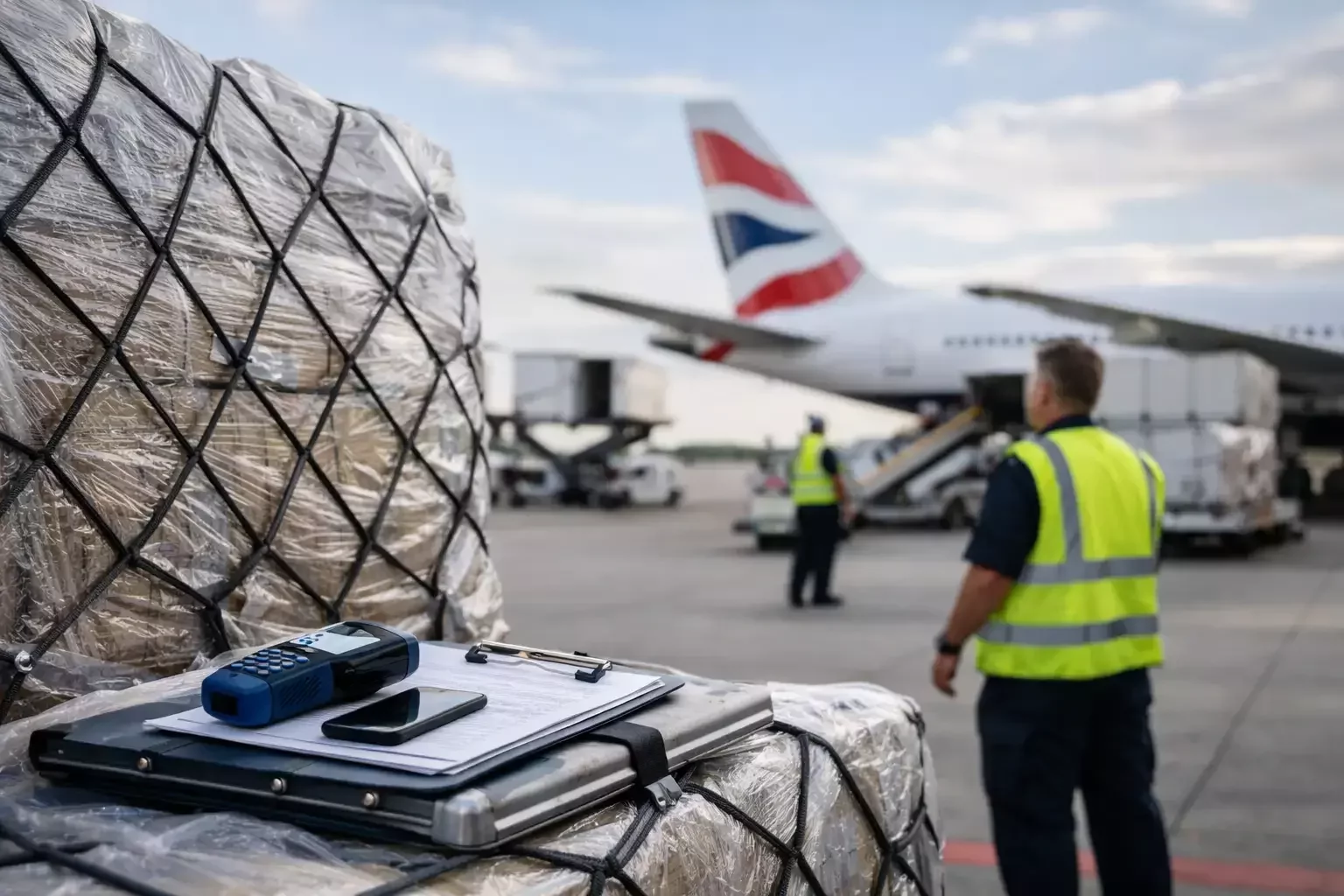
A flight can arrive on schedule, be accepted at the cargo terminal and still be unable to move to its final destination. For commercial importers, UK air import clearance requirements determine whether goods can be released promptly, held for further checks or placed into temporary storage while missing information is resolved. The most effective approach is to treat customs clearance as part of shipment planning, not a task that starts after the aircraft lands.
For air cargo, timings are often tight. Documentation must match the goods, customs data must be complete, and any licences or controls must be addressed before release is requested. This is particularly relevant for high-value stock, production-critical components and time-sensitive commercial consignments.
What UK air import clearance involves
Import clearance is the process through which goods entering Great Britain are declared to HMRC and, where applicable, other border authorities. A customs declaration establishes what the goods are, their value, origin, intended customs procedure and any duties or import VAT due.
For most commercial air freight consignments, the declaration is submitted through the Customs Declaration Service (CDS). The declarant may be the importer or a customs intermediary acting with the importer’s authority. The legal responsibility for the accuracy of the declaration remains significant for the importer, even where a freight forwarder or customs agent submits it on their behalf.
Customs release should not be confused with physical delivery. Once a declaration has been accepted and any required checks are complete, cargo may be released from customs control. The terminal handling agent must then receive the correct release instruction before goods can be collected or moved for airport-to-door delivery.
The core information needed for clearance
Clearance quality depends on the commercial information provided before arrival. A commercial invoice and packing list are central documents, but they do not replace the detailed customs data needed for a declaration.
The importer should provide a valid GB Economic Operators Registration and Identification (EORI) number, a clear goods description, the correct commodity code, country of origin, customs value, quantity and gross weight. The declaration also needs the applicable Incoterms, transport costs where relevant to valuation, and the intended customs procedure.
Descriptions such as “samples”, “parts” or “equipment” are rarely enough on their own. Customs classification must identify the product accurately enough to establish duty treatment, import controls and statistical requirements. For example, an electronic control unit, a medical device component and a lithium battery-powered product may all require materially different classification and compliance consideration.
The air waybill must also align with the commercial paperwork. Our guide to How to Arrange Import Air Freight for UK Businesses explains how accurate shipment preparation before departure helps avoid customs and handling delays after arrival.
Differences in consignee details, package counts, weights or goods descriptions can lead to queries at the terminal or during customs processing. Small inconsistencies are a common cause of avoidable delay.
Commodity code, origin and valuation
Three data points have an outsized effect on customs treatment: commodity code, origin and value.
The commodity code determines the tariff duty rate and can identify whether goods are subject to restrictions, licences, anti-dumping measures or additional declarations. Classification is not simply an administrative exercise. An incorrect code can create an underpayment or overpayment of duty, affect import controls and complicate future audits. Air Cargo Customs for Commercial Shipments explains why commodity classification, customs valuation and origin should be confirmed before cargo is booked rather than corrected after arrival.
Origin is the country in which goods are considered to have been produced or sufficiently processed under customs rules. It is not necessarily the country from which the flight departed. Where a preferential trade arrangement is claimed, the importer must hold appropriate evidence that the goods meet the applicable rules of origin.
Customs value is usually based on the transaction value, with specified additions or deductions where the rules require them. Freight, insurance, assists, royalties and commissions can affect the declared value. A low invoice value without supporting commercial evidence is a compliance risk rather than a cost-saving measure.
Documents that may be required
The documents required depend on the commodity, origin and procedure, but a standard commercial air import file will normally include the commercial invoice, packing list, air waybill and the importer’s EORI details. Where goods qualify for preferential tariff treatment, origin statements or supporting evidence may also be needed.
Certain commodities require additional approvals before release. These may include import licences, health certificates, phytosanitary documentation, catch certificates, conformity records or product-specific declarations. Goods subject to sanitary and phytosanitary controls, including some food, animal and plant products, may require pre-notification through the relevant border system as well as examination at an approved border control point.
Controlled goods demand earlier planning. This can apply to dual-use items, chemicals, goods with military applications, endangered-species products, alcohol, tobacco, medicines and selected waste streams. The exact requirement depends on the product and the regulatory regime. Leaving licence checks until the cargo has landed can result in storage costs and extended holds.
Dangerous goods are a separate operational consideration. Their carriage by air must be correctly declared and packaged before uplift, while their import customs declaration must still accurately reflect the goods, classification, value and any applicable controls. One compliance process does not replace the other.
Choosing the correct customs procedure
Not every imported shipment should be entered to free circulation immediately. The correct procedure depends on what will happen to the goods after arrival.
Most businesses import goods to free circulation, meaning duty and import VAT are accounted for and the goods can be used, sold or distributed in Great Britain. Import VAT may be accounted for through postponed VAT accounting where the importer is eligible and has made the appropriate arrangements.
If goods are moving onwards under customs control, a transit procedure may be more suitable. This can be useful where cargo is cleared at another authorised location or is moving to a customs warehouse. Temporary admission, inward processing and customs warehousing may also be relevant where goods are being repaired, processed, stored or re-exported, but each procedure has conditions, authorisations and record-keeping obligations.
The key point is to decide the procedure before the declaration is submitted. Changing course after arrival is possible in some circumstances, but it adds time and administration at precisely the point where air freight is often being used to protect a critical deadline.
Arrival, temporary storage and customs release
Before cargo arrives, the carrier or responsible party must meet applicable safety and security data obligations. The cargo is then presented to customs on arrival and normally held in a customs-controlled temporary storage facility at or near the airport until it is released or moved under another customs procedure.
Temporary storage is not a substitute for a clearance plan. Goods can remain in temporary storage for a limited period, but terminal charges can accumulate and operational options may narrow if documentation, payment arrangements or licences are unresolved.
A customs declaration may be accepted automatically, selected for documentary checks or referred for a physical examination. Selection is risk-based and cannot be eliminated by good planning, but accurate and consistent data gives customs and other authorities a clearer basis on which to process the shipment.
Once release is granted, collection must be coordinated with the handling agent’s procedures, security requirements and any delivery booking arrangements. For urgent cargo, it is sensible to confirm in advance who will receive release updates, who is authorised to collect, and whether delivery equipment or timed access is required.
Maintaining Air Cargo Tracking and Visibility throughout the shipment also helps importers prepare for customs release, terminal collection and final delivery without unnecessary delay.
Common causes of air import delays
Most clearance delays are not caused by the flight itself. They arise when data is incomplete, inconsistent or supplied too late. The following issues regularly create avoidable intervention:
- An invalid or missing importer EORI number, or uncertainty over who is acting as importer of record.
- A vague invoice description that does not support a reliable commodity code or control assessment.
- Incorrect origin evidence where preferential duty is being claimed.
- An invoice value that excludes information needed for customs valuation.
- Missing licences, certificates or pre-notifications for controlled goods.
- Air waybill, invoice and packing list details that do not match.
There is also a commercial decision around duty and VAT payment. If the declarant’s deferment account, guarantee or VAT accounting arrangement is not confirmed in advance, a declaration can be delayed even when the product information is correct. Importers should be clear about who is authorised to use any relevant account and how authority is recorded.
A controlled pre-arrival process
The strongest import process begins when the shipment is booked. The supplier should be given precise invoice instructions, including the legal seller and buyer details, goods description, country of origin, unit values, currency and Incoterms. If goods are regulated, licences and certificates should be checked against the actual product and shipment route before uplift.
The customs declaration data should then be reviewed against the air waybill and packing list before arrival. For repeat imports, maintaining an approved commodity and origin data file can reduce inconsistency, but it should be reviewed when products, suppliers, manufacturing locations or trade terms change.
A freight forwarder with customs capability can coordinate airline, terminal, customs and delivery activity through one operational contact. At ACS Air Freight, this means checking the shipment data early, managing the declaration process and keeping the importer informed if a customs query or border control action affects release timing.
For businesses relying on air freight to protect stock availability or production schedules, the practical test is simple: if the cargo arrived tomorrow, would every customs data field, payment arrangement and product approval already be available? If the answer is not certain, that is the point to resolve the clearance plan - before the shipment is handed to the airline.
Need help with UK air import customs clearance?
ACS Air Freight coordinates airline bookings, customs declarations, compliance checks and airport-to-door delivery through a single operational contact.
Whether you're importing urgent production components, commercial stock or regulated goods, we help ensure documentation, customs formalities and delivery planning are aligned before your shipment arrives in the UK.